Labor of Love
20210416_123215_edited.jpeg
20210416_123243_edited.jpeg

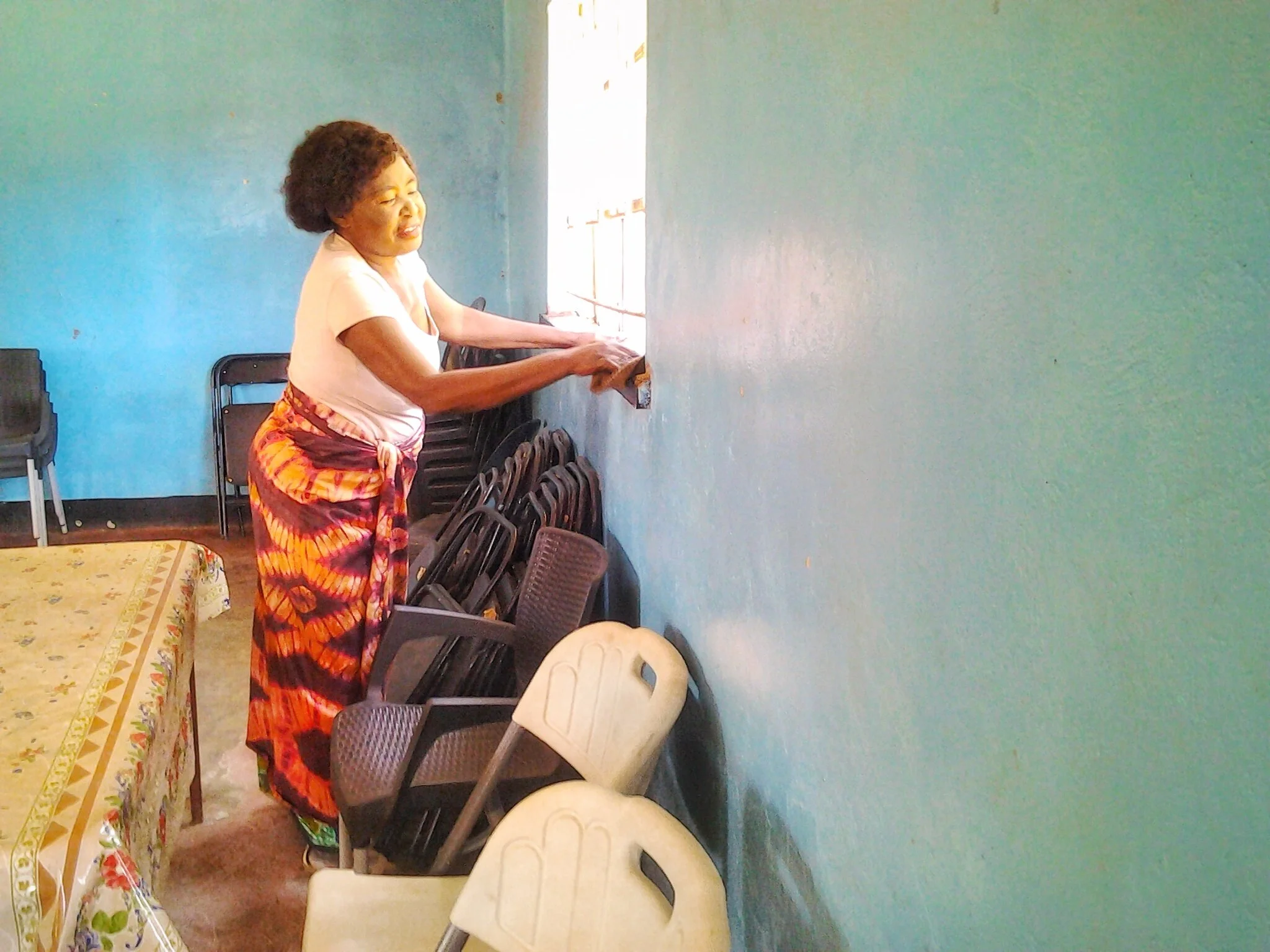
The Kafwa volunteers in Zambia are amazing in every way! Whether it’s visiting clients at their homes to provide basic health care and support, facilitating the Isubilo (grief support) group for orphans at the school, leading Girls Achievement Program (GAP) activities, or serving lunch to students, the Kafwa are beacons of hope in their communities, and the backbone of our schools. 

Often on Fridays at Mapalo Young Peace Makers Community School, these amazing women go one step further in their labors of love: while one group goes out to visit clients in the community, another group stays to clean the school. They sweep, mop, and dust the school, ensuring it will be clean and ready for another week come Monday! 

We want to uplift the efforts of the Kafwa! Volunteers who choose to make their communities, cleaner, healthier, and safer. Join us in thanking our friends!

Guest User
April Showers of Gratitude
Mapalo Kafwa visit client homes using their new umbrellas

Mapalo Kafwa visit client homes using their new umbrellas

“April showers bring May flowers”...many little drops of rain come together to create something beautiful - something that we’ve seen practiced in HealthEd Connect! We want to celebrate all of the people who come together to make our uplifting work possible. Your donor investment in our programs provide access to education and health services for underserved communities. Our board members provide leadership and vision as we deepen our programs and consider new opportunities. Our health worker colleagues continue to identify community needs, comfort and heal clients, and empower women and children in a myriad of ways! 

In Zambia, the first few months of the year are the rainy season. Our health workers still go out and walk to their client’s homes during this time of the year! In order to make these trips easier, funds are provided in their team budgets to purchase umbrellas, providing shelter from the rain, but also from the sun in the dry season. Something as simple as an umbrella makes a big difference as the Kafwa walk to visit ill clients. 

To all of the people who help make HealthEd Connect great - we thank you! Everything you do, big or small, makes a big difference in the lives of women and children. With hearts full of gratitude, we send our thanks!

Guest User
A Fairer, Healthier World
Murielle Ngando

Murielle Ngando

Kamina Mwewa

Kamina Mwewa

Tomorrow, April 7th is World Health Day, a special day recognized by the United Nations which highlights health issues like maternal care, child care, and mental health. This year, World Health Day is focused specifically on building a fairer, healthier world for all people. We feel strongly about uplifting this mission! 

Our Wasaidizi (community health worker) colleagues in Democratic Republic of the Congo are outstanding examples of creating more equal access to health care! Not only do the Wasaidizi serve rural communities as basic care providers and traditional birth attendants (TBAs), several have been formally trained to administer immunizations. In fact, two more Wazaidizi volunteers from the rural Kasenga area of DRC are starting vaccination training this year! This training thanks to a community health worker development scholarship awarded by HealthEd Connect. 

Certified vaccinators can be hard to come by in rural areas, making this training all the more important to vaccinate their communities against preventable diseases. Having trusted and trained vaccinators in the community makes it easier to distribute and administer immunizations against illnesses from Hepatitis A to COVID-19, creating more equitable access to preventative care, and healthier communities!

Our ability to provide these opportunities comes from donors like you! Thank you for uplifting health, education, and access to care as we work towards a fairer, healthier world for all!

Guest User
Ablution Evolution
Construction of the ablution block begins!

Construction of the ablution block begins!

At the Kasompe Community School of Peace in Zambia, a major improvement project is underway! Thanks to a generous Rotary grant, a new ablution block consisting of 8 toilets, 2 showers, and 2 hand washing sinks is being added. In addition, two pit latrines (for backup), a water tower, and borehole will be added to strengthen the sanitation system. 

Starting in 2018, Rotary launched the Water And Sanitation Hygiene program (WASH) in Schools. This target challenge was developed as a Rotary-wide effort to support sustainable sanitation systems. As described by Rotary, “Clean water, better sanitation, teacher training, and hygiene education in schools can improve the health and education of children by creating a cycle of opportunity: improved education, increased school attendance, and improved academic performance.”

Representatives of Kansas City Rotary Club 13, and Kitwe (Zambia) North Rotary Club, visited our school in Kasompe to see the existing dilapidated facilities and determined this initiative was a worthy project to support for the health and well being of the 450+ students and teachers at the Kasompe school. We are excited and grateful for the opportunity to partner with Rotary! HealthEd Connect and the Kasompe school board and teachers are elated to uplift student health and education through this opportunity!

Latrine construction

Latrine construction

Guest User
What Does Water Mean to You?
Construction of a latrine in Gorkha, Nepal.

Construction of a latrine in Gorkha, Nepal.

Today is World Water Day! 

This important day, recognized by the UN, brings attention to the life-sustaining, dignity-providing, peace-inducing element that is often easy to overlook.  Our volunteer community health worker (CHW) colleagues, however, do not take water for granted. Rather, they work hard to utilize the health benefits it provides their communities. 

Dr LEE Jong-wook, Director-General of the WHO emphasizes this topic so well in his statement: "Water and Sanitation is one of the primary drivers of public health. I often refer to it as “Health 101”, which means that once we can secure access to clean water and to adequate sanitation facilities for all people, irrespective of the difference in their living conditions, a huge battle against all kinds of diseases will be won." 

In the rural and mountainous area of Gorkha, Nepal, CHW Ramprasad has worked hard to educate the community about the importance of clean water and sanitation. Though “taking care of business” in the fields had been common practice, Ramprasad outlined the threats to public health and the need for latrines to improve sanitation for the entire community.  By March 2020, Ramprasad, with the help of community members, had completed 25 latrines, but then COVID delayed plans for continued construction. Now, a year later, construction has resumed and more families are gaining access to sanitary facilities, protecting them and others from a myriad of illnesses. 

Water is the most abundant, important resource in the world, yet is not always accessible to everyone. Today, on World Water Day, we join with the UN in inviting you to consider- What does water mean to you?

wwd2021_water2me_card_square-01.png
 
Guest User
Cooking Up Something New in Nepal
Pinkey and Sangeeta help a family test their new cookstove! 

Pinkey and Sangeeta help a family test their new cookstove! 

In Nepal, many families experience health issues caused by cooking smoke in the home. The resulting health issues disproportionately affect women and children, who spend the most time in the cook space. Volunteer community health worker and nurse, Sangeeta, and our Nepal coordinator, Pinkey, looked for long-term solutions. They connected with a vented stove manufacturer and found a cookstove they wanted to test in the community. In January 2020, two families in Biratnagar, Nepal received  cookstoves to test for everyday use.

This has been a great opportunity to put our promise of “evidence-based” work into action! After a year of improved health conditions, time savings and reduced resource usage, many other families in the community were interested in vented  cookstoves as well. Surveys were conducted to quantify and track the changes seen in families who were already using the stoves, and to help identify families who would benefit most from new stoves. Survey responses came back so quickly that within TWO WEEKS, twenty-five new cookstoves had been purchased and transported from Kathmandu to Biratnagar!

This fast-moving project does 3 important things:

1) Alleviates health issues felt most acutely by women and children.

2) Allows for real-time research that results in evidence-based decisions.

3) Provides an opportunity for families to contribute a small fee toward the purchase of their stove and thereby contribute toward a community fund that is controlled by community members for other community-led initiatives.

This advancement in community health is made possible thanks to donors like you! After big delays due to COVID, it’s now moving ahead by leaps and bounds!

Pinkey, Sangeeta, and Meena visit with woman at her home to discuss the cookstove

Pinkey, Sangeeta, and Meena visit with woman at her home to discuss the cookstove


Emily Penrose-McLaughlin
Choose to Challenge- International Women's Day
International Women's Day.png

What will you “Choose to Challenge” this International Women’s Day? In the words of spoken word poet, Anisa Nandaula, “Gender is a pre-written book, but not all the girls’ stories end the same.” Even today, there are girls forced into early marriages or actively kept out of school. Girls remain uneducated about their bodies, or the possibility of a future outside of marriage and motherhood. Our community health worker colleagues and school teachers  choose to challenge these issues and empower women and children so that this is no longer their pre-written story.

In all 4 countries where we serve, community health workers educate girls about their menstrual cycle and hygiene in an environment where they feel comfortable and unashamed. Women are taught family planning so they can have more control over the number of children they have.  Children are weighed and monitored throughout their first five years of life, making sure they are developing on track and have the chance to thrive.  These are things that often can be taken for granted, but can make a world of difference.

In Zambia, our Girls Achievement Program (GAP) for grades 5-7 includes team building, female development and hygiene, and emphasizes how important it is for girls to stay in school and avoid early marriage. After completing 7th grade, HealthEd Connect provides GAP scholarships for girls to continue their education through 12th grade, while offering academic and emotional support from a life coach. The Keeping In Touch (KIT) Club connects the two programs, giving younger girls the opportunity to connect with and be uplifted by the older girls who have continued on to pursue their high school certification. This cycle of role models helps to encourage GAP students that their education is important and worth the effort.  

We choose to challenge the lack of access to health care and education - both at home and in the classrooms. What will you choose to challenge this International Women’s Day?

Link to video by spoken word poet, Anisa Nandaula

Celebrating Education at All Stages
Brenda sits behind her friend at the Kafwa literacy class.

Brenda sits behind her friend at the Kafwa literacy class.

Denied the chance to attend school as a child, Brenda found a supportive community through the Kafwa (Zambian community health workers). She was first introduced to the Kafwa by her husband, Abraham, who was a Kafwa member himself. Abraham was blind, but a loyal and wonderful Kafwa member, navigating the village with the help of his daughter as he went to help his community. Sadly, Abraham passed away not long ago.

After the passing of her husband, Brenda was comforted by the other Kafwa. As they uplifted Brenda, the Kafwa challenged the older gender "norm" that only boys should attend school, and encouraged Brenda to start her education.

Now that she has begun, she is INSPIRED! Brenda shared: "It is of great joy that am in school for the first time in my life and this is all because of you friends!" Her excitement is contagious, and her profound desire to learn will be passed on to her children, and their children after. We are so proud to be supporting women like Brenda in their journey towards education and empowerment!


Psst... Important news! Our new website is launching NEXT WEEK on March 1st! We invite you to check it out! >> http://healthedconnect.org/

Emily Penrose-McLaughlin